





















Governor Gretchen Whitmer has created a new holiday—for certain taxes, that is.
A part of her “Save Michiganders Money Plan,” this will establish a set period in which families will not pay sales tax on back-to-school items. While a bit vague, the governor’s website claims it will apply to “school supplies, clothes, and certain electronics.” Ideally, come fall, this will help families save.
For the average household, though, will a temporary elimination of sales tax make a real impact?
Particularly in high school, students don’t need a massive haul of supplies every year. A new notebook or two, maybe some pencils, a binder—these are relatively low-cost items.
However, we’re often influenced to purchase more than just the bread-and-butter essentials. A new year is an excuse to recreate our closets or buy aesthetic stationery. Trevor Riley, an AP economics and history teacher at FHC, predicts that this contributes to the shopping boom each fall.
“I think that maybe just the cyclical nature of school, and the fact that it’s the beginning of the year—starting fresh, casting off the past, and entering into this new—can play into [students buying more school supplies],” Riley said. “Being a parent now, my kids are younger, so we get the list [of supplies], and then we just go buy them—but they haven’t really gotten super pumped about back-to-school shopping [yet].”
The governor’s tax holiday could make a noticeable impact for parents like Riley. In elementary schools, families are provided with a list of everything their child will need. These are typically comprehensive and specific. Costs can add up for families with multiple young children.
By contrast, high schoolers can generally choose what materials they use.
Riley mentions that it’s the “trendy” products that often motivate students to spend. In his school years, the “big thing” was the Trapper Keeper binder. Today, popular products tend to be a bit more extravagant—think The North Face backpacks or Stanley cups.
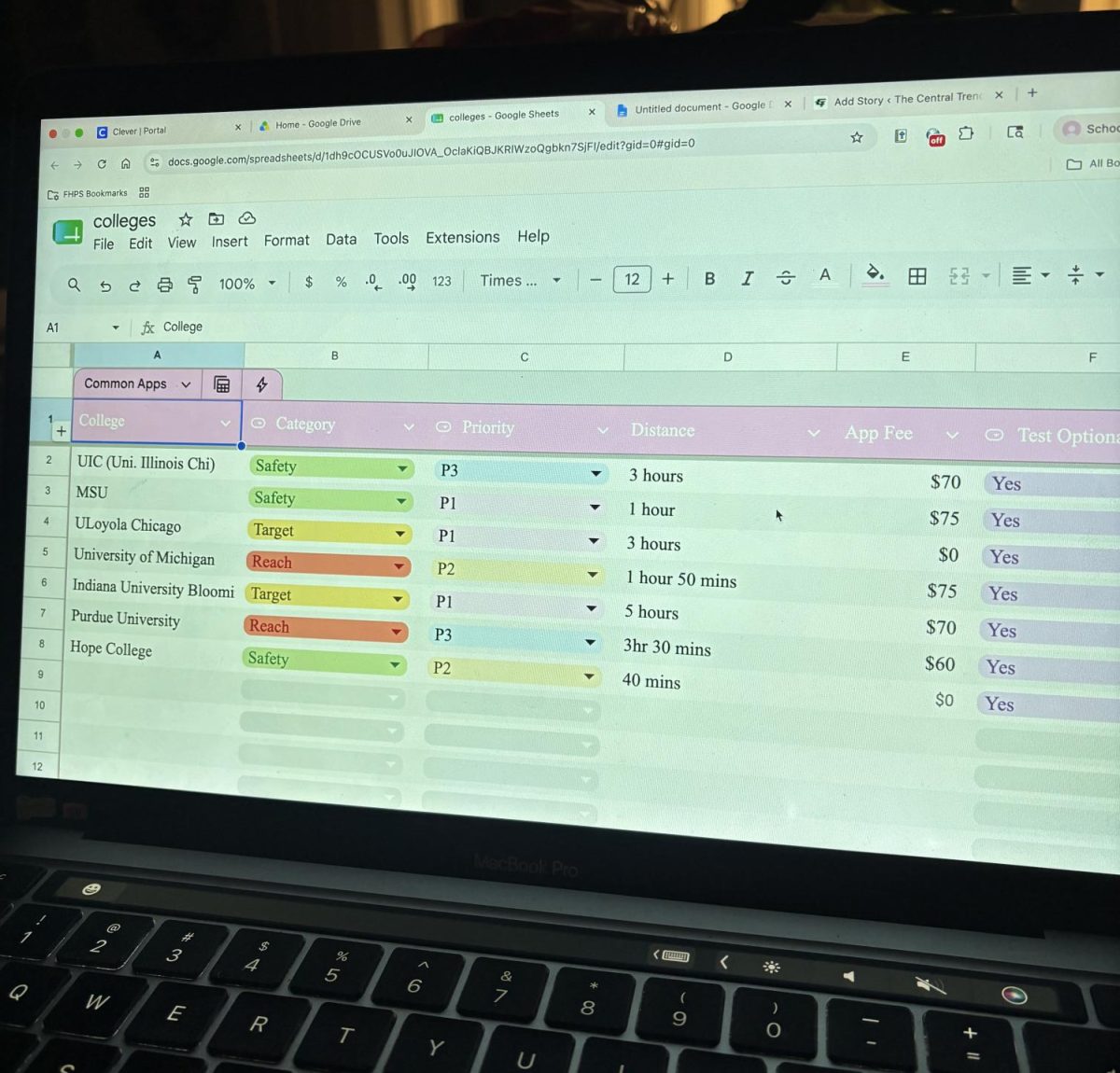
The biggest strain on families’ back-to-school budgets, though, is undoubtedly technology. If purchasing new technology this fall, the impact of no sales tax will likely be appreciated.
Principal Jonathan Haga emphasizes that many FHC students choose to bring their own electronics to school rather than use what the school provides.
“I think [technology] is something that provides a budgetary strain on our community and school because investing in technology isn’t cheap,” Haga said. “And so, yes, we could have a Chromebook for every student. But students don’t want Chromebooks, right? They want their MacBooks or their bigger technology. We can get four-function calculators for every single student, not TI-name-a-number graphing calculators that you can play video games on, too. I think that [students] do want the best for the classes [they’re] taking. I think that takes a big financial burden.”
While many high schoolers use their own laptops, others borrow school-provided Chromebooks. A set number of these are available for daily checkout in the media center. For long-term use, some students have Chromebooks that they’re allowed to keep throughout the entire year.
Despite these resources, the tendency to bring our own laptops to school might inadvertently create pressure to conform.
“I think that if we looked at our school and the demographics of our school, we would fall into a specific socioeconomic status,” Riley said. “And I think that we oftentimes just go about things without considering that some of our families are not necessarily in that average socioeconomic bracket. So, therefore, we have expectations on students—not that we don’t have things in place, but we still are a school [where] everyone essentially brings their own laptop [or] computer. That can be difficult—not that we don’t have Chromebooks in the media center—but the expectations, I think, are broad, and that can hurt some of our families more than others.”
Technology is not only expensive for families, but for the district as well. Because of this, FHPS itself will likely benefit from a sales-tax holiday. This could impact the cost of Chromebooks as well as other large purchases like copy paper and books.
Most of FHPS’s revenue (67%) comes from the state of Michigan. A large chunk of that money flows from our “per-pupil” allowance. This is the amount of money the district receives for each student. Currently, it sits at $9,608 per kid. This is why “count days” are so important—our district loses potential revenue if we don’t show up.
The per-pupil money is used for “costs associated with the day-to-day operations of our schools and other district buildings.” These include our traditional school supplies.
Assistant Superintendent for Finance and Operations, Julie Davis, shares that FHPS has plans to invest in more technology.
“A couple years ago, we had some federal funding to support us through the pandemic,” Davis said. “We were able to offer a ‘Chromebook take-home program.’ That ended because the funding ended. But we’re looking at, ‘Okay, how can we support families that maybe don’t have that ability [to buy their own electronic devices]?’ We’re looking at trying to do something similar in the next school year.”
The further we’ve crept into the 21st century, the more FHPS’ enrollment has dropped. It’s primarily due to an aging population in the district—there just aren’t as many young families. This means that there are fewer students generating revenue for the district.
Davis emphasizes that these financial changes are kept away from the classroom. FHPS continues to ensure that students are given the best education possible.
“We want to make sure we’re focusing on instruction—making sure that our students and our schools have the resources that they need,” Davis said, “and that we’re staying on top of best practices for [education]. We want to make sure starting early with our little ones that we’re building those strong foundational skills so as they matriculate through the system [they are set up for success]. If we can get things early, [then] you’re more successful as you move through the system, and you get to high school, and you’re in an AP class [in which] you can [have] that success, [and] you’re like, ‘Yeah, I can do this.’”
In Ranger Country, “back-to-school” will soon be on the horizon. High schoolers and middle schoolers have already chosen their classes for next fall, and a fresh wave of shopping is undoubtedly on its way.
When it arrives, FHPS families may not be paying sales tax, and they could see decreased costs. Regardless, Haga emphasizes that students should contact him if they struggle to afford necessary materials. FHPS will support its kids—whether with basic supplies, technology, or otherwise.
“I think first and foremost, one of the things to mention is that if there is any hardship, if you’re a student reading this, we have the ability to support you in any way—just come talk to me,” Haga said. “I think that’s important to know. We do have a lot of expectations because we’re able to do that and support any student that’s in need because our community is so great and provide our students [with] the computers, calculators, and everything that they might need to be successful.”
