




















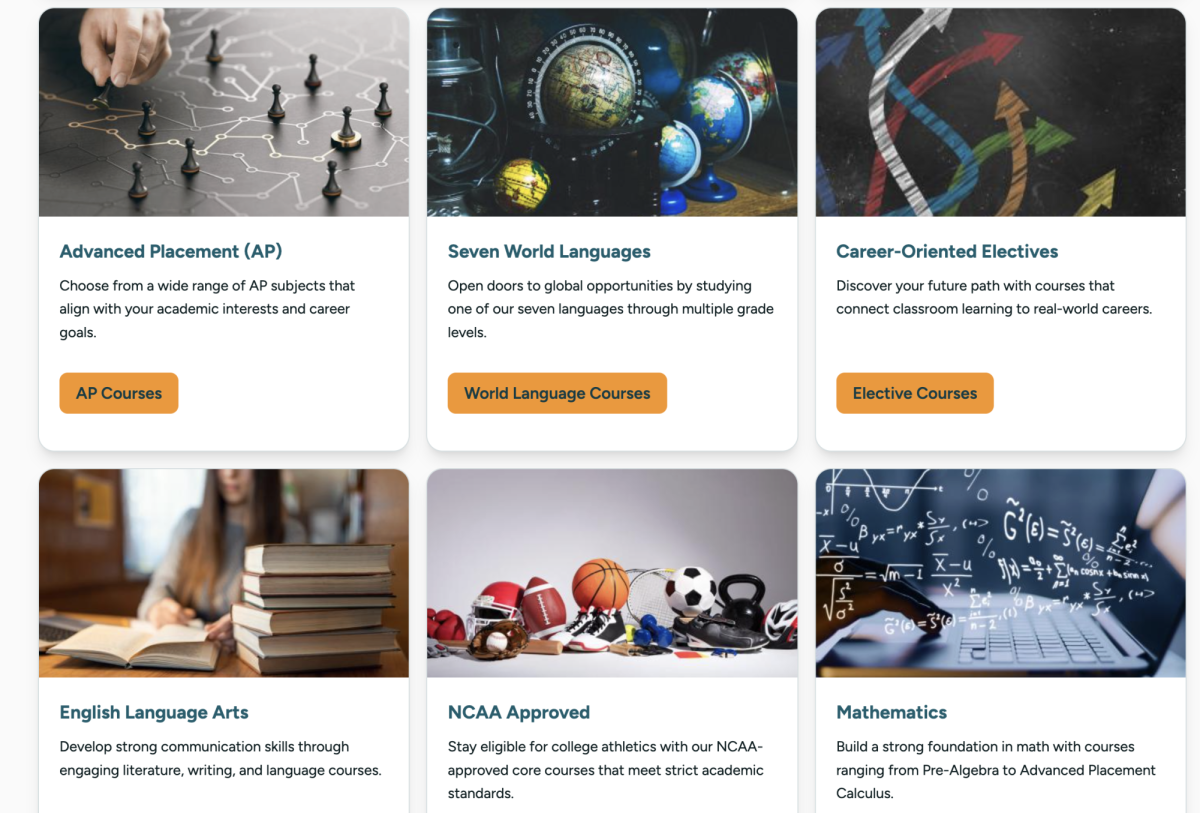
Despite the stereotypical notion of “summer school” destroying the blissful two months without school for high schoolers, virtual summer courses are becoming increasingly popular as an option to reach more advanced classes. For sophomore Lukas Kazmierczak, virtual courses have provided him with an opportunity to challenge himself in school. Lukas took Spanish 3 the summer before his freshman year, allowing him to take Advanced Placement (AP) Spanish this year, and Algebra 2 before his sophomore year. The independent structure of the course was what allowed him to find success in online summer courses.
“I did all my summer classes through Michigan Virtual, and it’s mostly self-paced,” Lukas said. “If you wanted to, you could submit every single one of your assignments on the very last day. There is a teacher, [and] he or she will oversee what you’re doing and make sure [you’re on track]. They’re also the person who grades your assignments, but for the most part, you’re left to yourself. For Spanish 3, I had to do speaking conversations with my teacher, but it’s really up to you how much work you want.”
With around 30 minutes to two hours of coursework each day, including weekends, Lukas’ summer schedule was significantly impacted by his online courses. By enrolling in virtual courses, students commit to staying dedicated to classwork throughout the summer.
“I would say that summer classes [took] a big chunk out of my day,” Lukas said. “It took a while, and I’d say I wasn’t able to have as much fun as I was hoping to during the summer, but it definitely paid off once the school year started. I was able to get ahead of my classmates and actually pursue things that are more exciting.”
In Lukas’s scenario, summer classes came with drawbacks while ultimately propelling him forward without too much detriment to his learning. Since Lukas aimed to challenge himself and heighten his knowledge, virtual summer classes significantly helped him. But for students looking to “check a box,” it’s often a different story, leading many teachers and counselors not to recommend summer courses to students. This unfortunate result is observed by AP Pre-Calculus, Algebra 1, and AP Statistics teacher, Rebecca Lipke.
“In the situation where a kid is exceptionally bright and accelerated in math, [virtual courses] would be a good thing for them to do, because they’re curious,” Lipke said. “They want to learn because they want to learn, but there is a super small percentage of the kids who actually fit into that category… What we have is a lot of our kids who just purely want to get ahead to say that they’re accelerated… and then they find out in the end, once they get to those high-level math classes their senior year, that they never should have accelerated. So we run into people who are accelerating for the wrong reasons.”
Summer courses are only effective if taken for the right reasons, and currently, there is little way to police this since students can register for courses independently. Without adult guidance, virtually enrolled students are often unaware of how much they lose in the classroom.
“[When taking a virtual course, students] miss out on discussions, miss out on conversations, miss out on disagreeing with somebody about something, arguing about how to solve a problem, or not understanding how a partner did it,” Lipke said. “[They] miss out on all those little things, and if [they] miss out on that every single day for 180 days of a school year, because they took the class during three months in the summer on their own online with no discussion, [then] they miss a ton.”
However, there are cases apart from exceptionally motivated students where summer courses can be an option. For students who have not received credit for a class or are missing a graduation credit, virtual summer courses are a way to recover without taking another full-year class. School counselor Victoria Velding only recommends summer courses in certain cases, with credit recovery being one of them.
“Taking a class in the summer is good if you are somebody who maybe needs to recover [credit], because then you can get caught up, or if you have a missed requirement somehow,” Velding said. “Otherwise, if we’re talking about advancement, I don’t really recommend that. Summer is the time that you need to focus on working and enriching those other parts of your life, rather than focusing on academics. There’s more to who you are than just the classes you’re in. So, ideally, it would really just be those who may need to catch up.”
Still, there is nothing like an in-person class with a teacher and a daily classwork schedule. As summer approaches, it is crucial for high school students to be aware of the potential effects of taking virtual summer courses as they prepare their schedule for the next school year.
“None of these platforms follow our curriculum, so [learning] in person gets [students] access to our teachers to help you,” Velding said. “Especially something like a world language, we can’t guarantee what you’re learning online is going to align with what you would learn in class. So, if you try to advance over the summer, it can get tricky because you’re not learning our curriculum, [and] you might be behind; it’s not going to be at the same place. Learning [in person] is a completely different experience from the online environment.”
