













There are 195 countries in the world. I feel like that seems insane; there should be closer to 3,000. But then, I realize, not every location is its own country. In the United States, it might as well seem like each state, with its own cities, rules, locations, and scenery, is its own country.
Now, Hawaii is basically its own country. Only accessible by boat or plane, it is far beyond accessibility to other states. From Los Angeles to Honolulu, the flight is still six hours long. I’ve flown to many cool places—Washington D.C., Arizona, and Cabo—but Hawaii was jaw-dropping. It really started my change of thoughts on the entire trip.
Out the window, the land filtered through an on-off cycle of dark sea, and then a mountainous island, and back to sea again. You always hear about islands, but only until flying over one, or many in this case, did I realize that they are so small, surrounded by water on all sides.
Being on the islands felt like a movie. Every single car had a Hawaii license plate, typically with the classic rainbow design, but some with other Hawaii-inspired art. Everyone was greeted with “aloha,” and thanked with “mahalo.” Surfboards littered the island: on the side of roads and sidewalks, in the cities, on the beaches, in cars, being carried who knows how far on top of someone’s head. Flowers grew naturally everywhere you looked, with bright colors of purple, pink, orange, and yellow, and palm trees could be seen in every direction.
We started in Honolulu. Every morning, my dad and I woke up before sunrise to walk on the beach when the sun came up behind Diamond Head, the crater at the end of Waikiki Beach. When we walked, the beach was usually decently deserted, but the water was full of people floating with surfboards. They started surfing before dawn, and anytime throughout the day that you looked at the beach, at least five surfers could be found. The buildings all had a touch of Hawaiian style; even the McDonald’s looked like it was straight out of Moana.
Even outside of Honolulu, not one place I looked was a boring sight. In Michigan, driving can mean staring at hours and hours of forests, or hours and hours of fields, and honestly, it becomes repetitive. In Hawaii, even if you’re staring at the same thing, it seems so unique and different; just a second later, it never becomes boring.
In the suburbs, I could stare at the houses side by side, with surfboards and towels and bikes and more resting against the fence or in the yards. The neighborhoods showed the culture and individuality of each family.
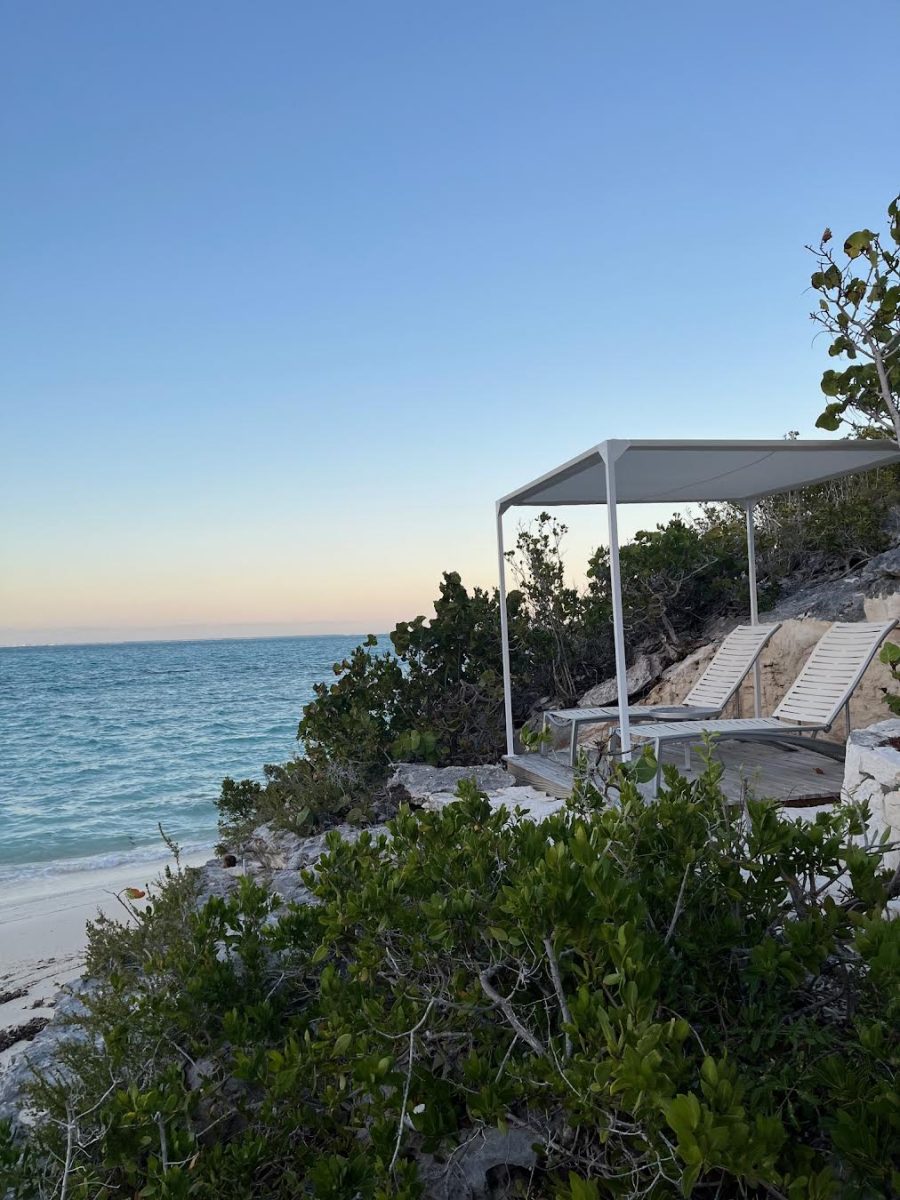
Around the mountains was rainforest, with birds flying and different types of greenery at every step. Near the beach, the waves were huge—nothing like the ones in Michigan. They were a Gatorade teal color and ever-so-elegant as they crashed. Each town was different, with boutiques, houses, restaurants, and food trucks.
There were chickens everywhere, and I’m still not sure why. We saw a seal on the beach at some point, as well as birds, lizards, fish, whales in the distance, pets like cats and dogs, and even a free-roaming peacock. From anywhere on Oahu or Maui, you could see the mountains and volcanoes. They reached so tall that the clouds blocked about a third of them. They were green with vegetation, but at night, they were decorated with little lights for the towns and houses reaching up over and through them.
Maui was drier than Oahu because of its Lahaina wildfires a few years ago, but there was still a type of striking beauty to the island. The roads tilt on cliffs of jagged rocks with blue water flowing over them. Every few miles, the scenery would dramatically change. At one point, we were between two volcanoes in a field, then we were driving along a cliff and the ocean, then we were at sea level next to a narrow beach, then driving through dry, destroyed towns, then in green beach resort areas, then driving through pine trees, and then in the middle of a rainforest on a one lane road that if steered too far to one side, you’re either pitched off to the ocean or in the side of a mountain.
I can’t truthfully say this for Oahu, but in Maui, snorkeling felt like listening to “Know Who You Are” from Moana. Underwater, everything had a different sense of peacefulness. As I floated near the top, all sound halted through the thick water, with lives carrying on beneath with totally different experiences than I could ever imagine. Sea turtles swam through wide, sandy ridges between coral, every once and a while reaching up for the touch of sunlight. Eagle rays majestically glided through the smooth water near the coral in a pair. Two fish swim in spirals around each other in between the surface and the reef. Everything was so perfect in order, interacting and living in a silent world below the crashing waves, boats, and people above them.
Beyond any sights, scenes, or moments, there was something about the culture of the islands that made me feel moved for reasons I’m not really sure of. At the Lu’au we went to, it was very commercialized, even cheesy, and obviously appealing to tourists. But, as the show proceeded, there was something about the native Hawaiian people dancing and performing their culture for all of us. Many people say that the Hawaiian natives and locals can be rude and harsh, and although we never experienced a speck of discourtesy, I wouldn’t blame them. In the United States, at least, we try to be environmentally friendly, using paper straws and reusable cups and whatnot, but we still have our faults: immense litter flows through the country, and almost anywhere you are, you can probably pick out an out-of-place piece of trash.
In Hawaii, there were still pieces of trash or items now and then, but so many times, all I could see was nature. They don’t litter as much there. Just in general, they’re so protective of their islands and their ecosystem, and they want them to flourish and stay in their natural state, that yes, as more and more tourists come and houses and resorts are built, it’s going to take away from all of that. So much of their culture is the land and nature. It’s one of their main priorities, which is something that so many of us can learn from. Even in their everyday activities and hobbies, they’re connected with nature. There’s hiking, surfing, snorkeling, farming, and so much more. When you think of Hawaii, the first thought that comes to mind isn’t the Honolulu Brandy Melville, although it may be a close second. I think of pineapples, rainbows, whales, hibiscus flowers, and surfing.
Sometime, eventually, along the line of my life, I want to go back. I want to take six months, live there, work on a boat, and spend my time in nature. I want to go to different places along the island, hike trails, swim on different beaches, learn to surf, and go back to this one açai place that had the best açai bowl I’ve ever had—every day. And then maybe after that, I can understand living my life to the fullest and being aware of the world in a different way.
I mean, there’s just no place like Hawaii.
