















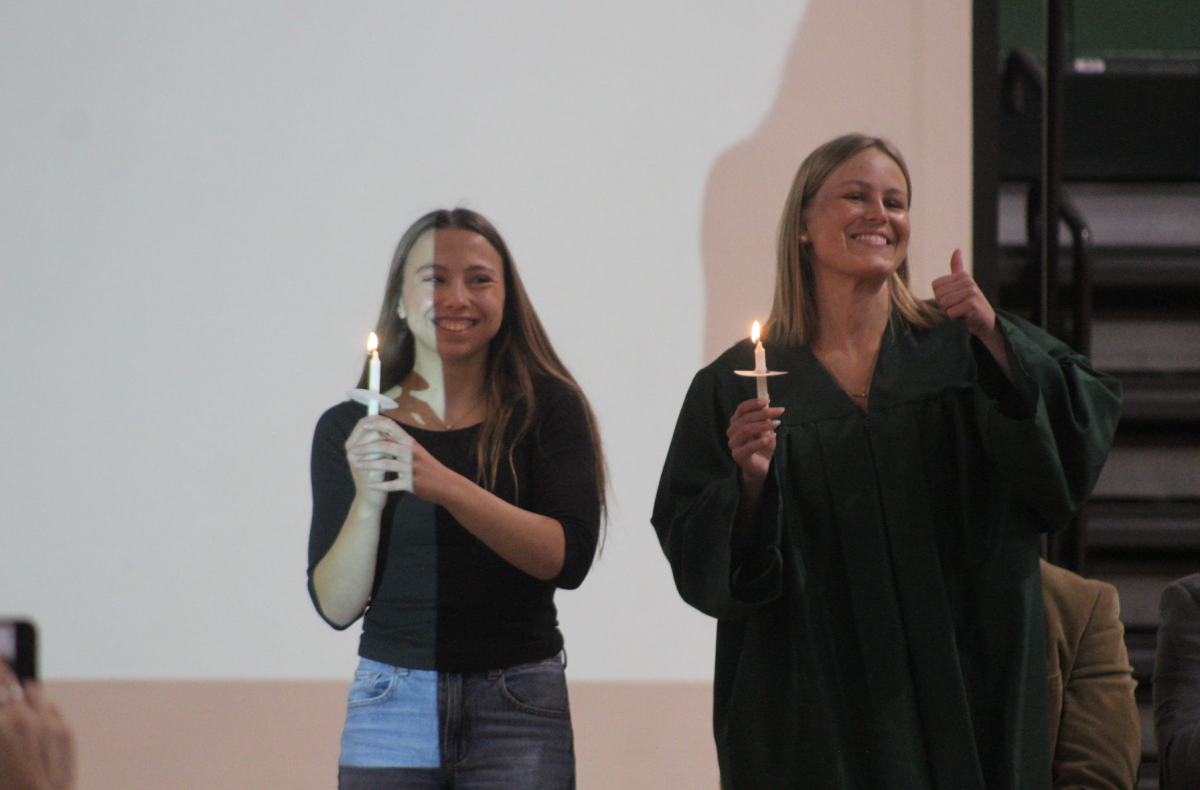


Senior Kristin Hotaling’s turning point was the American Revolution.
Well, Chapter Five of her AP United States History (APUSH) textbook, that is. Before her sophomore year, Kristin had no inclination toward history.
“If I’m being honest, I hated history [before APUSH],” Kristin said. “I thought that it was really boring because 90% of it was just recall. I felt like it was a useless subject.”
Kristin was placed in the class of former FHC history teacher Steve Labenz. Because of Labenz’s passion for the subjects he taught, Kristin was motivated to immerse herself within the curriculum. What made the American Revolution—and following APUSH periods—the most interesting for her was the connections she could draw between eras and ideas.
“What I find so interesting about [history] is its relevance to today,” Kristin said. “I’m getting older, and I’m starting to think more about my political views and my views on the world. I think that looking back on history can really help your perspective [on] today because history does repeat itself.”
A concept of particular interest to Kristin is revolutions. In today’s political climate, she finds societal instability and tension to be closer to a reality than something solely a part of the past.
Kristin’s favorite historical era—the Napoleonic period—is naturally one of great political upheaval. The early 19th-century events reflect history’s domino effect: the American Revolution greatly inspired the French Revolution, which had a resounding global impact, initiating change in countries across the globe.
“I think that change and profound change are what allows history to happen,” Kristin said. “Even things that seem small and seem like they wouldn’t have much of an impact can change the world for the worse or the better.”
Napoleon, undoubtedly, had a profound impact. While his actions are condemned by some and praised by others, his controversiality is what makes him especially interesting to Kristin.
If Napoleon hadn’t risen to power, the Holy Roman Empire could still exist. Further, World War I and World War II may not have happened. With such a significant way of shaping the last two centuries, Kristin considers Napoleon an underdiscussed figure.
She believes that others should find their historical rabbit hole of fascination—their own “Napoleon.”
“I just find [history] interesting,” Kristin said. “Being able to find something that you love learning about, and just being able to learn every single thing you can learn about it is something that I love. I think it brings a lot of comfort.”
Sticking with the theme of overlooked historical figures, Kristin’s favorite president is none other than the late 19th-century James A. Garfield. Though his impacts may not be as far-reaching as Napoleon’s, his decisions in office paved the way for pivotal changes to the government. In particular, Garfield had the ambition to install a merit-based system to award administrative jobs, replacing the one based on social and economic status. Creating an air of intrigue, he was a tragic hero, having been assassinated midway through his presidency.
Kristin stresses the importance of miscellaneous historical knowledge, like facts about Garfield. She is a new member of FHC’s Improv team, and being able to call up random facts helps her create funny performances.
“For Improv, knowing history just gives you so much worldly knowledge,” Kristin said. “Knowing about certain things—pop culture, history—things that anybody would ‘get’ is important to be able to create scenes that everybody can enjoy. That worldly knowledge just comes in handy where you have to make something up on the fly and, therefore, have to know about it.”
Inside of the classroom, Kristin sees the value in history for her English courses. Naturally, being able to connect a book with its historical context aids her in writing.
This year, however, Kristin is enrolled in no history course for the first time in her academic career. While it’s been an odd adjustment, she enjoys the free time she has to research without the constraints of a curriculum.
Whether through books, podcasts, or otherwise, Kristin emphasizes the importance of exploring history by oneself.
“Just find a time period that you like,” Kristin said. “Find something that you enjoy learning about and try your best to become an expert on that so that you can have conversations with people about either what you like or what they like. From there, you can just grow, understand more, and branch out because once you learn about one little thing, you then want to learn everything about that thing. It grows and expands, and you’re just able to learn more and more.”
Considering the current political climate, Kristin finds it especially crucial to learn history.
In the Diversity, Equity, and Inclusion (DEI) purge of the Trump administration, websites containing information about Black, Indigenous, LGBTQ+, and other minority groups’ histories have been shut down. With the sources narrowing of where one can obtain official historical knowledge, Kristin emphasizes not letting history be forgotten.
“I think that [paying attention to history] is incredibly important, mostly from the standpoint of the fact that we’re losing it,” Kristin said. “Having the ability to know your history so that you can pass it forward and teach it to other people and have conversations about the past, I think, is becoming more and more relevant with the current situations politically.”
