


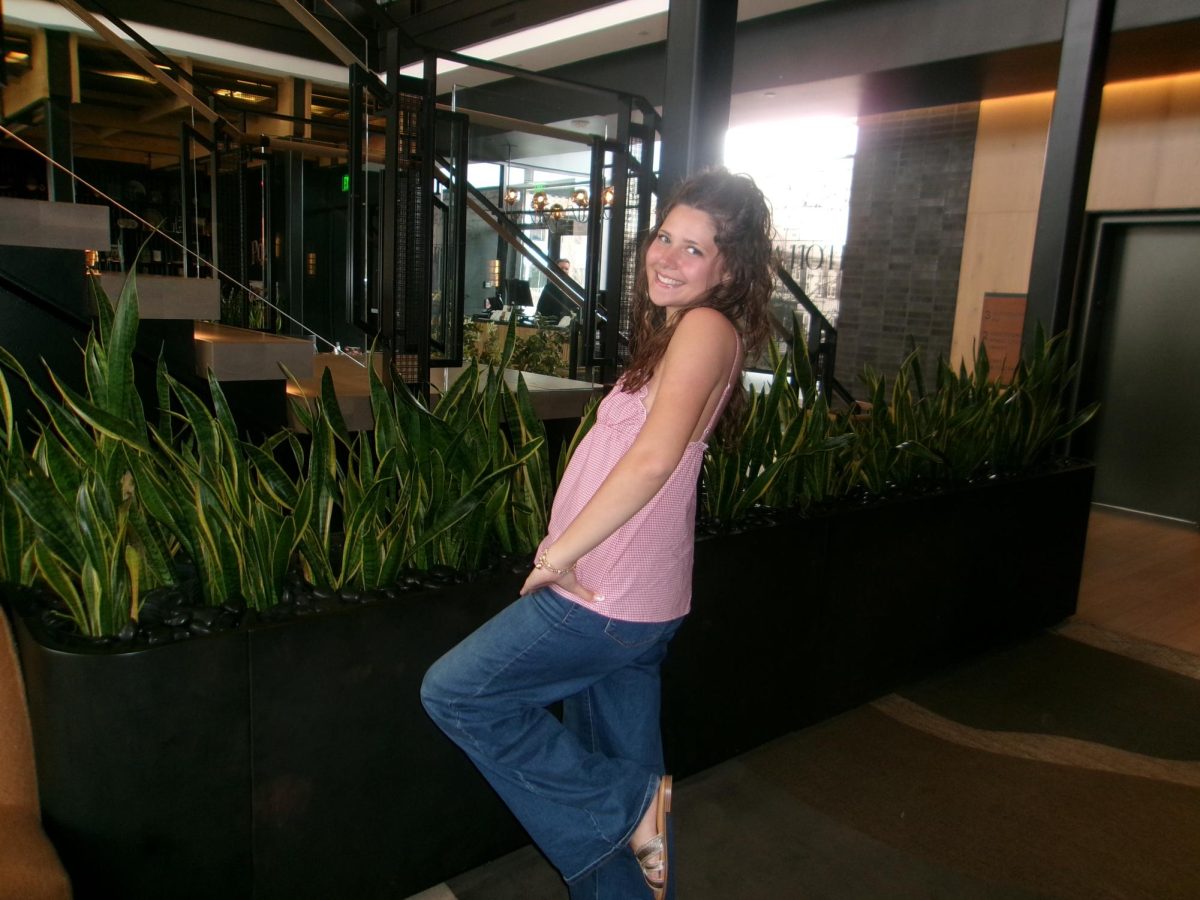













After three years of excelling in all things English and History-oriented, I surprised basically everyone in my life by adding Advanced Placement (AP) Chemistry to my senior year schedule. For weeks into the school year, my friends and family continuously questioned my choice of course, and with good reason. I have never loved science, even hated it some years, and math has always been my academic Achilles heel.
Now, as first semester comes to a close and I’ve gotten a chance to reflect on the class, I can confidently say that no part of me regrets my decision. Sure, I’m not great at chemistry—full transparency, I haven’t received a test grade above 85 percent all year—but I love it.
Taking chemistry, a class that is basically light-years outside my comfort zone, has not only taught me things that I never would have gotten the chance to learn otherwise, but through this course, I have also learned more about myself and the concepts that I do intend to pursue in the future. I firmly believe that everyone should be willing to take classes out of their comfort zone and general area of study.
Nothing in education is solitary. I have always tended towards the poetic and humanitarian side of coursework, rather than the analytical, mathematical classes, but in taking AP Chemistry, I am realizing that they are one and the same.
It is in chemistry, one of the most scientific, factual, and rigorous classes that I’ve ever taken, that I have heard some of the most poetic, symbolic phrases and concepts uttered.
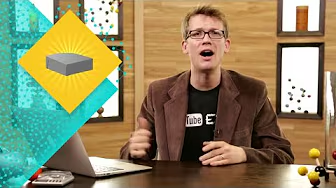
“It turns out that reality is like a kind of music,” said Hank Green in a Crash Course Chemistry video about electrons. But he didn’t just say it. He didn’t just create a metaphor to make understanding electron clouds and configurations easier; he scientifically and historically proved the harmonics of electrons with facts and evidence to back up the theory. Of course, Green is not the creator of this theory that electrons work like a symphony, but he is the messenger who brought it to me, and with it, my emerging love of science.
In the past, I would never have classified myself as a scientific person. When asked about school, I would state that I am more interested in history and poetry than equations and solutions, but I’m not quite sure that’s how it works anymore.
Electrons are the basis of existence. More than compounds, more than molecules, more than atoms, electrons are the binding energy that creates matter. That is a scientific fact. We would not be here without electrons; nothing would be here without electrons. And if science proves that these infinitesimally minuscule building blocks function in the same way as a symphony, in the same way as music, what is anything if not a cacophony of art and science merged into one, uproarious melody?
It’s because of this that I so strongly believe in the study of multiple genres of education at once. It is counterproductive to limit yourself to just STEM (science, technology, engineering, and mathematics) classes or just the arts because it better benefits your future career, when the truth is that they are one and the same.
When electron waves settle on a B-flat scale and sentence structures match mathematical equations, it becomes clear that the separation of knowledge and understanding about the world into categories is a supreme waste of time. Why should we divide our understanding of the universe when it is the accumulation of it all that makes humanity truly intelligent?
