


























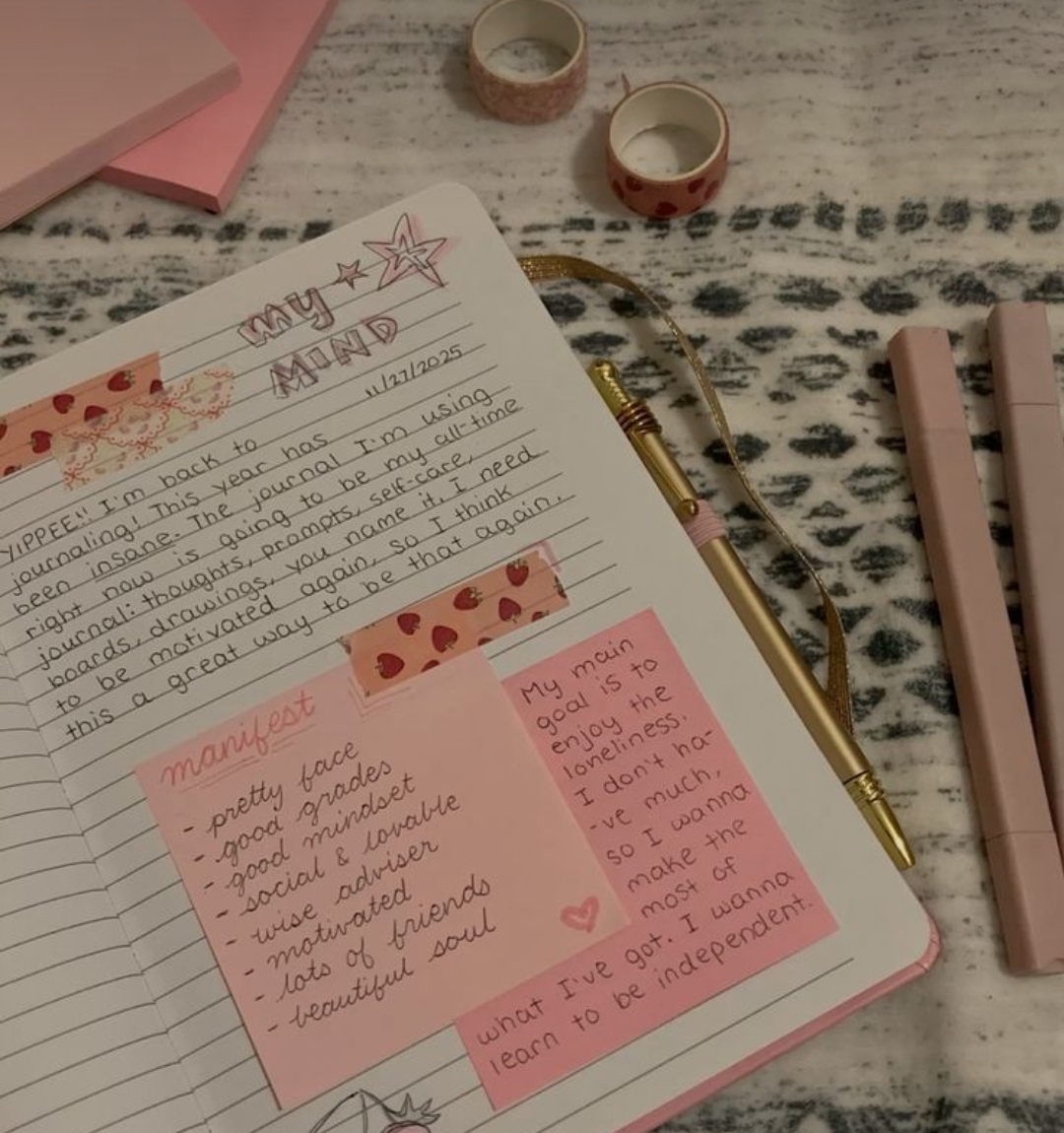
I started journaling a few months back after ending a relationship and needing some way to reflect. It didn’t start off as journaling exactly, but more along the lines of writing letters to myself. By taking the time to reflect and organize my thoughts into words, I was able to experience a surprising amount of personal growth and overcome hurdles that seemed hopeless. Over Christmas, I received my first official journal and have spent every night since writing for at least an hour before bed. Of course, it’s not necessary to write that long, but it’s a nice way to destress before bed and revisit your day with a deeper analysis.
- Decide what type of journal you want
There are many different ways to journal. You could get a lined journal, allowing you to focus more on the writing aspect. Another option is to choose a plain journal, allowing you to doodle and express yourself more freely with your writing. Personally, I use blank paper so that I can draw graphs and little drawings that go alongside my writing. Whichever type of journal you choose, it’s important that you are able to write in it comfortably. Journaling doesn’t have to be expensive or aesthetic; it just has to be authentic. When I first started, I used ripped-out paper from an old Meijer notebook and kept it in a box.
- Write with intention and habit
I would highly recommend writing daily. By writing daily, you improve your consistency and are able to reflect on each day individually. Consistency becomes a habit, and once journaling becomes a habit, it’ll become hard to forget. While I write for at least an hour each night, that’s not necessary at all. Writing for five or ten minutes can be just as productive. Your journal is personally made for you, whether that means writing about your day, or writing poems or songs; as long as your own thoughts are on paper, you are journaling. It doesn’t matter when you write or for how long, just as long as you do. You can write on the bus to school or while doing a face mask—anytime that you can take a break from the day.
- Topic
Your journal is personally yours, meaning you can write about anything you want. Most people write about their day to keep track of their life. Your journal can even become a keepsake that you look back at to keep memories with detail, both good and bad. However, if keeping a detailed account of your day seems overwhelming, take it slow. Reflect on one moment from your day or write a poem. All that matters is that your thoughts are on paper and you are taking the time to think things through. Not all journals have to be sad or happy, detailed or simple, creative or analytical.
- Be creative
Journals are not all about the words you put into them. Personally, I like to draw little illustrations that go alongside the topic I’m writing about. There are no strict guidelines or boxes you have to check. Making little graphs, charts, or lists to keep track of things is an option, or just scribbling abstract nonsense that doesn’t make sense to anyone but you. Maybe you want to underline a sentence or color-code words with certain colors; anything is allowed. Whatever makes the most sense to you, personally, is best.
Overall, there is one important thing to remember when journaling: You are not writing for someone to read, you are writing for yourself. This phrase was particularly hard for me to follow when I first started journaling, as I’d be afraid to write something down, fearing someone would judge me; I’d exaggerate or understate elements of my life to cater to an audience that didn’t even exist. If not that, then I’d fall into perfectionism and rewrite sentences so they would make more sense when read back, but no one was reading them back. This philosophy stands true for anything in your journal. If you’re drawing, it doesn’t have to look pretty; it just has to exist. If you’re making a list, it doesn’t matter if it’s out of order. All you have to do is write. Everything else is up to you.