















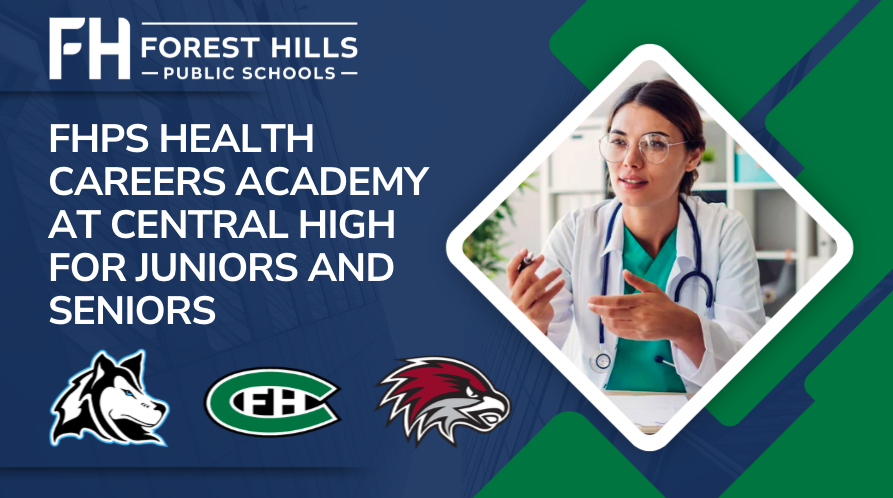
As I planned my schedule for the next school year last spring, one option stood out to me: Kent Career Technical Center (KCTC). KCTC is a program that offers career-focused pathways for students. While the opportunities there were appealing, the limited program acceptance and transportation challenges made it difficult for me personally. However, this upcoming school year introduces a new opportunity at the high school: the Health Care Academy.
Students can participate in the Health Care Academy hosted at FHC, which offers first-hand experiences to see what the medical field looks like for upperclassmen. This academy is not only an alternative to KCTC but also provides students with more experience in the medical field. FHC principal Jonathan Haga has made sure that the new program coming to the school is a class that students want to engage in.
“So last year in Forest Hills, [the district] had 80 students apply for the KCTC medical program, and of those 80, only 20 got in,” Haga said. “So, 60 students did not have the opportunity to follow a career path or a pathway of learning that they wanted. In addition to that, [the school] sent out elective data that [the students] all filled out. And, it was loud and clear that what you guys all wanted was more opportunities to see a potential career in your learning.”
KCTC is still a reliable option for incoming juniors and seniors, but this new opportunity provides possibilities to get a head start on future careers within the school building. FHC Vice Principal Jacob Strotheide explains how the Health Care Academy can help accelerate students’ career process in the future.
“[The district was] looking for opportunities for our students to be able to dive into the health career paths, finding new initiatives to engage in [the students’] learning,” Strotheide said. “This opportunity came up, where Ferris State University reached out and said, ‘Hey, we have this program where [students] can earn credit, have project-based learning, and potentially earn some scholarships towards Ferris, but also credit towards other universities.’”
Ferris State, a local university to FHC, has partnered with the school to support the new class. This new program coming to the school aims to mix the college lecture experience with a regular high school class.
“This opportunity came up, supported by our admin, through Forest Hills Public Schools, because all three schools have the opportunity to [participate in the Health Care Academy],” Strotheide said. “But, also through our building, with Mr. Haga kind of supporting it as well. So, really, what it comes down to is that students will go meet with a Ferris State professor twice a week. The other three days will be used for research-based, program-based classes to be taken, slash, doing research, community learning, and exploration.”
This approach moves healthcare education beyond the classroom, giving students the chance to explore future careers through real-world learning and college-level instruction.
“So [the Health Care Academy] is a dual enrollment program hosted here,” Haga said. “And with that, as a senior, they take what’s called senior projects. We are partnering with a lot of different organizations around West Michigan, near 28th and Cascade, with Mary Free Bed and Corewell [Health]. So [the students are] gonna have the opportunity to work on a hybrid model where you might shadow somebody in the medical career. [Students] might have a five-week experiential learning opportunity where they get their [Certified Nursing Assistant] or a different endorsement in the medical field. They might work with our athletic trainers and learn trauma response.”
Beyond experimental learning, the academy also provides multiple academic pathways for students interested in healthcare careers.
“So for juniors, if they have taken AP Seminar, they can sign up for AP Research as part of that healthcare academy,” Haga said. “And so that would put you on track to complete the healthcare academy with the AP Capstone diploma. They also have the opportunity, if you didn’t do AP Seminar, to just join it and take anatomy and physiology, which follows the biomedical sciences track. And then with that, you would also take the Ferris State classes, which are two and three-credit courses, which could transfer to a couple of schools, but also to undergrad credits.”
The flexibility the program offers is one aspect that has drawn interest from many students, including junior Anna Morris, who plans on entering the medical field as her future career. The five-week experience the program offers has caught the attention of many students on the same path as Anna.
“[The program] is good because [students] can change it to accommodate what they want to pursue,” Anna said. “If I wanted to become a surgeon, I could shadow the surgeon, and I could focus more on that. I think that the program at KCTC could be pretty hard, but I think that this one could attract a lot of students, because it offers more opportunities.”
Opportunities provided in high school are very appealing to students who are confident in their future careers, which helps accelerate their participation in the academy.
“[This program is exciting] because it is a medical opportunity that does not require me to go out of my way to participate in, so I do not have to leave school,” Anna said. “I do not have to do anything outside of school, and it provides a whole bunch of special opportunities for students like shadowing opportunities, which is something I am really looking forward to participating in.”
