


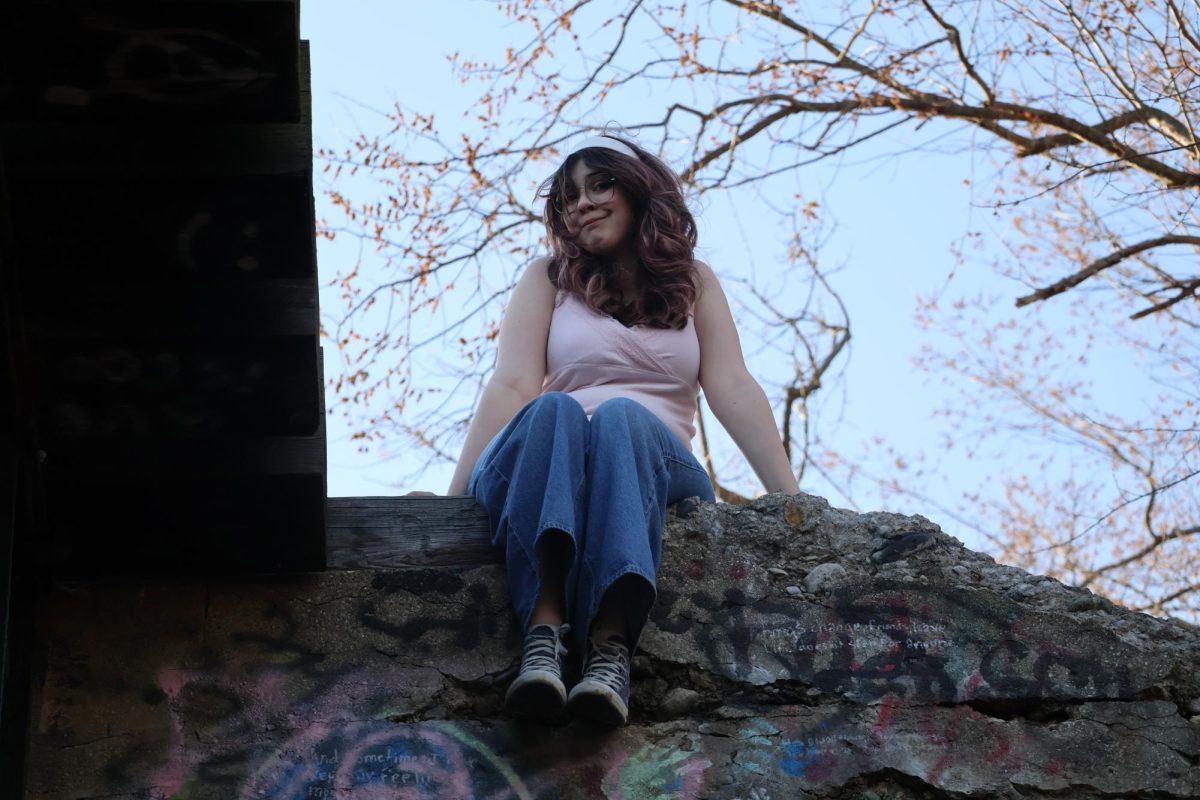











True crime: some find it extremely disturbing while others consume so much of the genre that they could solve a crime without any professional training. And for some others, learning about the real murders, burglaries, abductions, and other crimes of history is interesting enough for them to pursue a career in the field. Sophomore Andrea Hurtado Lafont fits into this last category.
An exchange student spending the 2026-27 school year away from her home in Madrid, Spain, she is interested in a unique area of study.
“The most important thing that got me [into being] a criminologist was watching true crime shows,” Andrea said. “I just wish I knew why people [commit crimes]. Like, ‘What’s on their minds?’ I want to understand that, so that kind of goes with psychology too.”
While she’s not certain exactly what career she would like to pursue in the vast field that is criminology, no matter what, four to six years of schooling will be required.
In Spain, post-secondary education is either entirely free for students or quite cheap, so money is not a factor. This is vastly different from the U.S., as many high school students are forced to rely on scholarships or student loans, which can take anywhere from five to over 20 years to pay off.
This means Andrea must maintain a high GPA and pass the Prueba de Acceso a la Universidad (University Entrance Exam) with flying colors in order to get into their desired college or university. Fortunately, she is strong in her academics and is confident she will be able to go to her college of choice.
“The [college] is [called] Universidad Autónoma de Madrid—I want to go [there],” Andrea said. “I don’t really care if I go to that one or not, but that’s the one super close to my home, and I heard it’s really good. It’s public, so you don’t have to pay. I don’t think [at all], if not [it’s] just a little bit. And, I think they offer criminology there.”
One might wonder, if she has such a solid plan for what she wants to do in Spain, why would she need to travel to another country for her education?
After her brother participated in the exchange student program and went to Wisconsin, Andrea was interested in expanding her knowledge about the U.S. Because she loves to travel and her brother enjoyed his school in America so much, she figured it would be a good fit for her. While she’s traveled to many different areas of Spain and other European countries like France and Italy, she hadn’t yet been to the U.S. Unfortunately, like her brother, the experience with her host family didn’t go as she expected.
“First, I had this not really good host family,” Andrea said. “I was there for two and a half months, and then I changed [to be] with [my new host family, and it’s] really good there. I feel like the program helped a lot because as everything about the last family happened, I changed [shortly] after.”
Thanks to her new and improved host family, she has gotten the chance to fully experience American high school. This includes extracurricular activities like volleyball, which is her preferred sport back home in Spain. However, the structure of the sport is quite different between the two countries; in her school in Spain, the season lasts nearly the entire year, and practices are on Tuesdays and Thursdays. In the U.S., however, student athletes only get two to three months out of the year for their sport, but practices are more frequent, being four to five days a week. Still, she enjoys volleyball no matter what country she’s in.
“[I play volleyball] because it’s a sport I’ve been doing for six years,” Andrea said, “and since in Spain seasons last nine months, I do it almost all year long. And I just love [playing] this sport.”
Among the many cultural disparities between the two countries, Andrea has adjusted to the difference between the structure of the average Spanish and American high schooler’s day. For this school year, she has had to walk up and down the stairs and all around the school in order to get to the six different classrooms she takes courses in. This is different from what she has grown used to in her hometown of Madrid, where, rather than the students, the teachers travel from class to class to instruct their respective courses. She also has to wake up much earlier to make it to school on time, which has been another adjustment for her.
Despite these changes, Andrea has been content with her time in Michigan, but there’s still one thing she cherishes about Spain.
“Schedules are later and all of that, but I’m pretty used to it [now],” Andrea said. “My favorite thing about Spain, besides my family and friends, [is] just the food and environment…I feel like food is such a big thing [there].”
Often, when exchange students come to the U.S., it’s assumed that being a foreigner is the only interesting or important thing about them. However, people like Andrea have many different parts 0f their personality besides their nationality. Still, being an exchange student is a unique trait that only a few students at FHC have in common. This shared experience has brought Andrea closer to the ones who can.
“I’ve [become] good friends with Maria [Seda], who’s from Spain too,” Andrea said. “I think the fact that we both are away from our families and [that] this is all new to us made us connect because we have experienced the same things. I haven’t really had a chance to talk to [many other exchange students], but I feel like since we all have the same feeling, same experience, it’s just [a] great community.”
