























The reason I began The Central Trend was that I would be able to share my writing capabilities and ideas with the world. Knowing that the words I choose so carefully could impact a person to change their ideas or opinions is so powerful. I love that I’m able to reach people, no matter who they are, with letters on a keyboard.
Essays have always naturally become something that I never hated. It was another way for me to express what I was thinking or arguing. In my Advanced Placement (AP) World History class, the essays that call for students to evaluate and argue are some of my favorites. It’s a way to assess history and show the negative and positive impacts that past leaders have chosen.
Every student who has taken any AP or English class in their life knows that writing takes time. There is the process of coming up with your idea or thesis, writing the draft, editing, continuously looking over for mistakes, and then finally polishing your paper. Some of the best writers can do this in a few hours, while others find that it can even take them days to create something they’re proud of.
As someone who places academics as a top priority, getting feedback from others and advice is valuable. To have another person tell me my words have affected them, or that I can improve and broaden my horizons, will forever impact me.
When I was introduced to Class Companion, though, my entire world shifted a bit. It sounds dramatic, but really, it is the start of something much more negative in education. It has not only begun harming classrooms, but it also truly tarnishes the relationships between teachers and students alike.
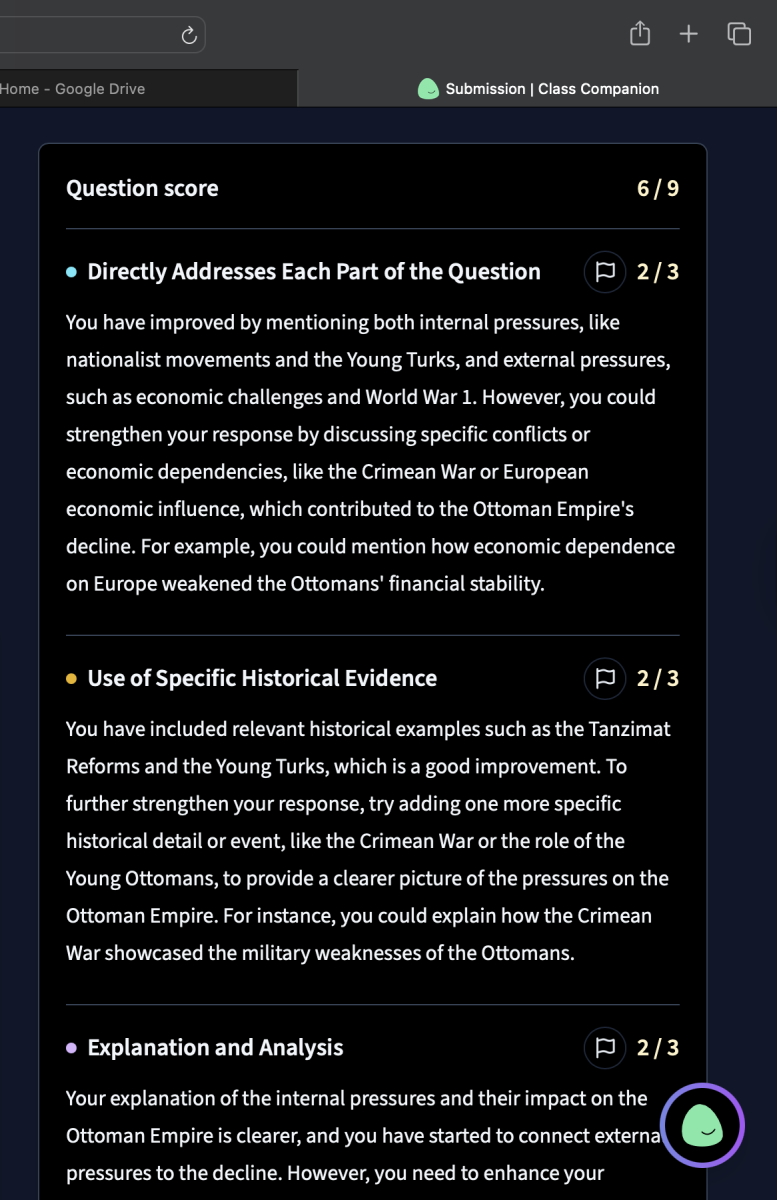
Class Companion is an AI writing website where teachers can create prompts and “plug in” their rubrics. Students will then type in their essays or answers, getting feedback from the AI bot almost instantly.
At first glance, it seems great. Instant feedback can be helpful when it comes to grammar, punctuation, and distinction—easy fixes that can be identified and looked over quickly. Except, when a bot is grading an entire essay—with a claim, evidence, and reasoning—that’s where it becomes more problematic.
My teacher started off by having us type in our essays and receive feedback, and then he looked over it himself. This gave us some automatic advice, but it also allowed our teacher to grade them as well. The difference in my last Friday class was that I was told that the entirety of our essays would be graded by AI. No ifs, ands, or buts. The grade AI gives you is correct, meaning, your grade was solely determined from whatever the bot wanted to give you. Mind you, before this, not a single person through all of the world history classes had gotten a full score.
So why was my grade being determined by someone who doesn’t teach me?
The number one issue with this is that AI is and has been wrong on numerous accounts. It’s a robot, actively being improved upon, and it will never fully be correct. It doesn’t have experience like humans do, meaning that everything it spouts cannot be trusted. Its input and sources aren’t always correct either. You can blatantly see this though the Google AI answers that appear at the top of the page whenever you search for something, which have been wrong countless times for basic answers. Factually, it cannot be trusted to grade students’ papers well either.
It doesn’t know people’s regular tones of voice in essays. It doesn’t know what has been taught already and what hasn’t been. It doesn’t know the students on an emotional level to give feedback that actually makes sense to them. It simply doesn’t know enough to take over a teacher’s job.
On an emotional level, it ran much deeper than that. My own anger stemmed from the fact that using such websites shows no concern for students. It, honestly, exemplifies an ignorance and frank carelessness about what students have worked on. It lacks respect for students, something that we are supposed to show ourselves, but is not shown by our role models. If a student stayed up trying to perfect an essay to show their teacher, the least that the teacher can do is read the paper. Isn’t that part of the job, anyway?
I want my words to have meaning. I want a human to sit down, read my paper, and tell me what I can do to improve and what they like already. I value that opinion. Knowing that my work is being recognized should be the least I can expect from those who are supposed to teach me.
Students have been told again and again: do not use AI. It’s cheating, it shows laziness, and a lack of gratitude for the education they have been given.
So why, if I am told this, can my role models use it time after time again?
What does this show to high schoolers—who are told to focus on their academics—when their own teachers convey no care over their assignments?

Katty Anderson • Mar 18, 2026 at 9:40 am
i wholeheartedly agree with all of this 🙌