


























On Apr. 29, the Supreme Court ruled 6-3 in Louisiana v. Callais to reduce the power of the decades-old Voting Rights Act of 1965 in a decision that could potentially destroy diverse state legislative representation and voting rights. In the decision, a Louisiana congressional map was struck down as the district lines were determined to be an unlawful gerrymander. Gerrymandering, the process of manufacturing unorthodox district lines to sway political voting power for a certain candidate or political party or unlawfully create congressional districts, can be seen on maps throughout the U.S., to varying degrees. Generally, the more uniform and geometric a congressional map is, the less “gerrymandered” it has become.
The distribution of voters into districts that separately elect congressional representatives for a state legislature is a formulaic process that should be determined in a nonpartisan way. In terms of accurate resident representation within legislatures, gerrymandering is the quickest way to remove this democratic principle. However, the issue of gerrymandering for political gain is not the crux of the Louisiana v. Callais ruling; the ruling targets the Voting Rights Act in the name of reducing racial gerrymandering and paves the path for partisan-influenced congressional maps.
The Voting Rights Act, specifically Section Two, was created to allow for minority regions that are large enough to exist as their own county to be formed as a separate district, to ensure their votes are properly represented by state representatives. The creation of these majority-minority districts provided representation and the ability to increase minority voters’ influence, and Section Two was one of the most influential elements of the Voting Rights Act. Just because the U.S. is 70 years removed from the passage of the Voting Rights Act does not mean that minority vote dilution has disappeared; the need for minority representation and protection is still prevalent.
By effectively rendering Section Two of the Voting Rights Act useless in the name of reducing gerrymandering, the congressional lines that allowed for increased power of minority voters will disappear, and the court inherently allows for congressional lines to be drawn based on partisan influence.
As dissenting Supreme Court Justice Elena Kagan put it, “Under the Court’s new view of Section 2, a state can, without legal consequence, systematically dilute minority citizens’ voting power. Of course, the majority does not announce today’s holding that way.”
This not only destroys the power of minority voters, but it also permits one-party-controlled state legislatures to influence state maps and create districts that will reduce the democratic influence of voters from the opposite party. Although the intentions of the ruling aim to reduce racial discrimination in state elections, it instead enables discrimination through the suppression of dissent votes in majority-controlled houses and the loss of minority representation.
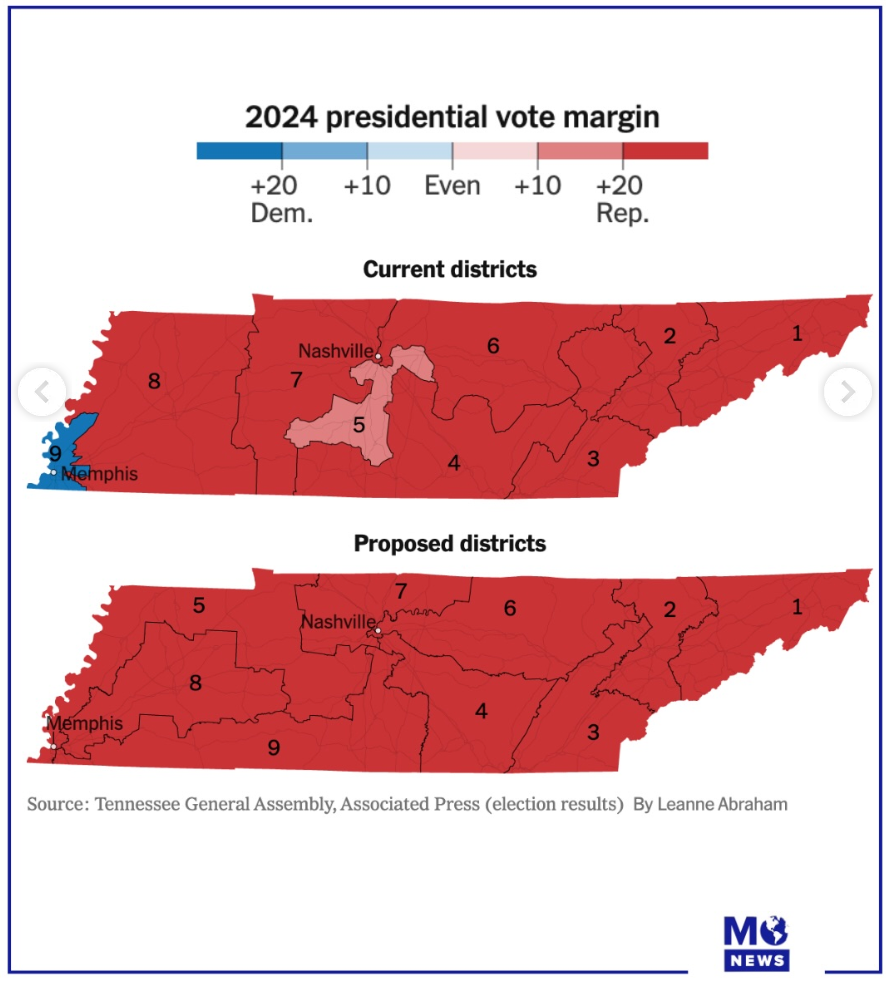
Not yet a month after the ruling, the effects of Louisiana v. Callais are rippling throughout the U.S., most notably in the district redrawing of Memphis, Tennessee. A region which was, as of the day of the ruling, the only Democratic county in Tennessee, has since been redrawn to create three larger districts that encompass rural areas and section the city into three. All three of these districts are now Republican-dominated.
With the destruction of Section Two of the Voting Rights Act, this redistricting is now permitted and cannot be challenged under the discriminatory intent clause. Make no mistake—the redistricting of Memphis is a direct result of the loosened restrictions on minority-protected districts to “protect” against racial gerrymandering. The power of minority voters in Memphis has been lost in favor of creating a unanimously Republican Tennessee legislature.
This ruling is against every principle of democracy that the U.S. claims to represent. It restricts the democratic power of millions of minority voters and entrenches power within political parties, rather than in the votes of Americans. Louisiana v. Callais is a devastating blow to millions nationwide, and the effects of the loosened restrictions on political gerrymandering will only become increasingly evident as power is continuously stripped from the people.

lily • May 15, 2026 at 2:09 pm
great article brooke
Janaiya • May 15, 2026 at 8:22 am
This is so good!