













Many would consider middle school to be the prime time to read Young Adult (YA) books, such as The Hunger Games, Red Queen, and Harry Potter. While I would agree, I ended up waiting to read the most popular YA series until my junior year of high school: Percy Jackson and the Olympians (PJO).
By this point, I’d already watched the first season of the TV adaptation, which I thought was wonderful—save for a few too many black-screen transitions and watered-down action sequences. Regardless, I was incredibly excited for the second installment, with episodes releasing on a weekly basis beginning this past Dec.
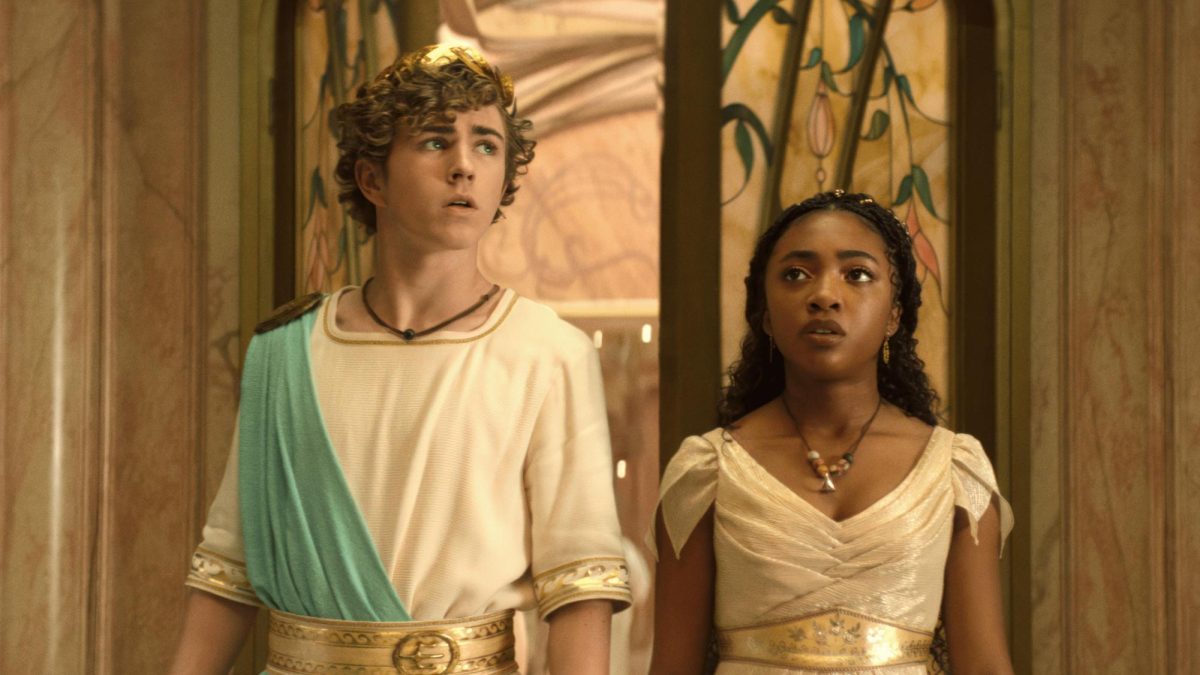
This highly anticipated season follows Percy Jackson (Walker Scobell) and one of his best friends, Annabeth Chase (Leah Sava Jeffries), as they travel into the treacherous Sea of Monsters. They’re on the hunt for the mythical Golden Fleece, which has the power to restore health to the failing border around Camp Half-Blood. Without it, monsters will lay siege to the refuge and all its young demigods. In addition, Percy and Annabeth hope to save their other best friend, Grover Underwood (Aryan Simhadri), who’s trapped by the monster Polyphemus. Rounding out the supporting cast are Clarisse (Dior Goodjohn), Percy’s friendly nemesis and newfound Cyclops half-brother, Tyson (Daniel Diemer), and Luke (Charlie Bushnell), Percy’s not-so-friendly nemesis.
The creators of Season One took a more subdued approach to visual effects and overall spectacle, but they ramped up the ante in Season Two. With intense stunts and gorgeous sets that brought the book to life, I was immersed in each episode. (I especially loved the Scylla/Charybdis battle in Episode Four.) Its main cast are also older now, giving the show a darker, more mature feel, as well as a renewed display of vulnerability and emotion from every character.
This season took several creative liberties, all of which were approved by the series’ creator, Rick Riordan. The most major one came at the end of the season finale, involving the tree at the border of Camp Half-Blood that contains the spirit of one of Zeus’s daughters, Thalia (Tamara Smart). Although I won’t reveal any spoilers, it came as a surprise to me—whether it’s good or bad, I haven’t yet determined.
One of my few grievances about Season One, unfortunately, was not improved: the epidemic of ghastly lighting and bland color vibrancy in recent media. Wicked (2024) is a prime example of this; audiences were disappointed with the stark coloring contrast between the drab Oz in the film and the visually arresting brilliance of the Oz depicted in The Wizard of Oz (1939). Seasons One and Two of PJO were no exception to this trend. The fantastical monsters and settings of the novels were often tinted grey to a painful extent.
However, I enjoyed most of the season’s new aspects, especially the focus on dialogue between Percy and Annabeth. Since the show lacks Percy’s famous narration from the books, the screenwriters instead extended spoken banter between the lead characters. The most prominent example is in Episode Five, when Percy and Annabeth are marooned on Circe’s island resort. When Percy discovers his fatal flaw, he tells Annabeth a crucial piece of information—“So if I had to choose between saving you or saving Olympus, Annabeth, I’d burn it all down.”
Initially, I was slightly bitter about the omission of the famed “Siren Scene,” but now, I don’t mind it at all. The aforementioned line was not in the book, but Scobell’s delivery and the screenwriters’ choice of diction had me trying to conjure a nonexistent memory of reading it last year. Throughout the season, similar changes were made, but Scobell and Jeffries’ sublime acting skills made me appreciate this new version of one of my favorite novels.
Despite a few deviations from the impeccable source material, Season Two affirms that Percy Jackson and the Olympians remains a worthwhile watch.
