



















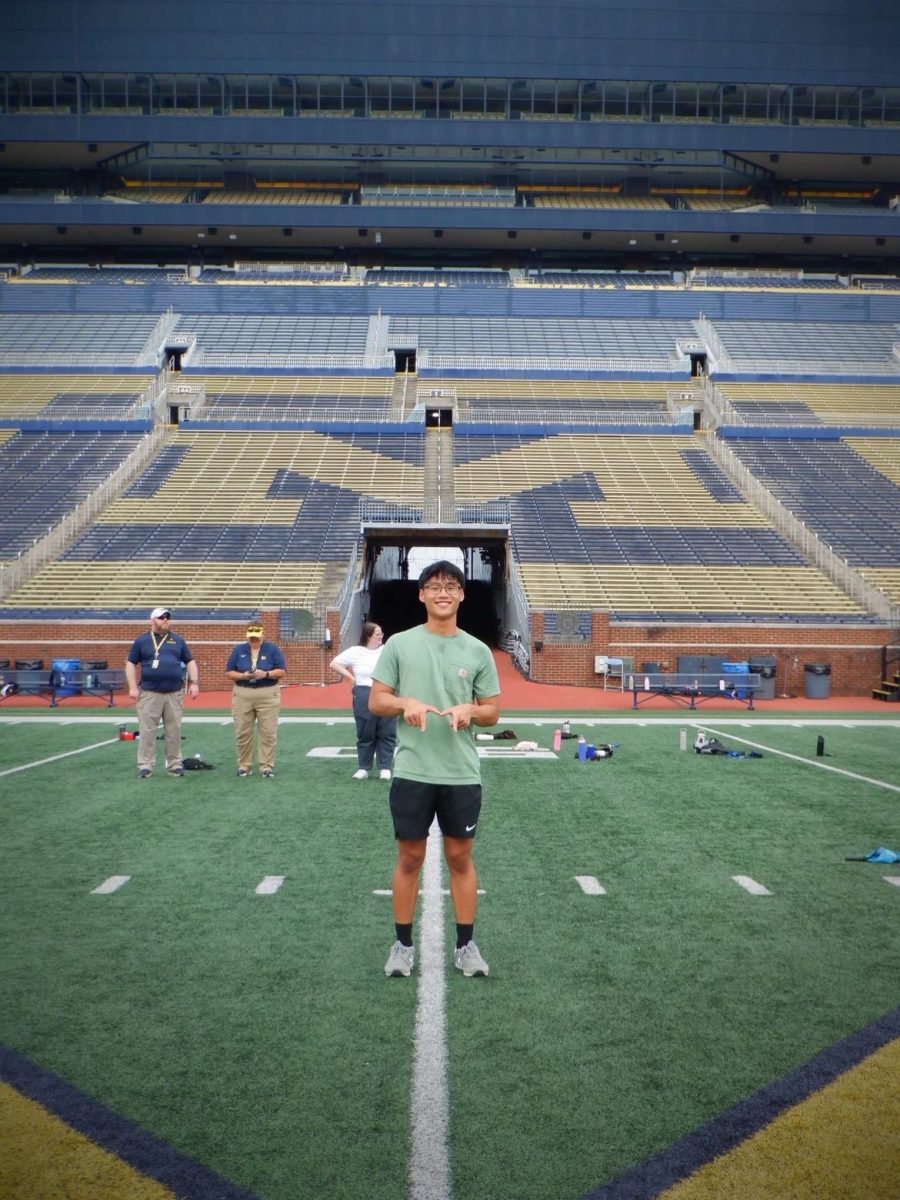
Don’t panic.
This is what senior Frey Wu told himself during last year’s tumultuous tariff season. Faced with a volatile market, he impulsively sold his stocks. Only later did he, president of Forest Hills Charitable Investments, realize his mistake.
“Remember when [President] Trump announced tariffs on Liberation Day?” Frey said. “And the stock market tanked [around] 15% in two days? That was a very stressful few days. In all the time that I’ve been managing [Forest Hills Charitable Investments], stocks don’t really go down—until they do. And when they do, you’re completely unarmed, with[out] any experience of that happening. And so your first instinct is to ‘panic sell,’ right?… But 99 times out of 100, that’s an overreaction. Panic selling at the bottom is never the right idea.”
Once the market rebounded, Frey discovered that his decisions had ultimately lost him money. This experience showed him the importance of anticipating what everyone else is doing—and then proceeding to do the opposite. In the words of Warren Buffett, Frey learned to “be fearful when others are greedy and greedy when others are fearful.”
This mantra gets at the psychology behind the stock market.
“I think [the stock market] is basically the world’s biggest game,” Frey said. “It’s not just about how much you think the company’s worth and whether you think the company’s a ‘buy’; it’s whether you think everyone else thinks that. You have to determine what everyone else thinks, and if there’s a difference in what you think, there’s implied value in that. It’s much more than buying companies; it’s a lot of reasoning and research inside it. It’s a lot of fun.”
Through Forest Hills Charitable Investments, a club at FHC, Frey shares this interest in finance with others.
Meetings take various forms, with some including guest speakers and others being volunteer opportunities. Most importantly, the club is a space where students gain financial literacy skills.
In small teams, members often pitch stocks to the larger group. These pitches include rationales for why a stock will rise, and they allow students to practice navigating the market. From there, the club invests (real) money into these stocks. At the end of the year, they donate a portion of the profits to local food banks.
Frey emphasizes that working with the stock market requires one to understand how other people think.
“I think people that think that [the stock market] is boring aren’t really in the weeds enough,” Frey said. “When you first get into it, it’s like, ‘Why does a stock move up and down?’ It seems completely arbitrary. You think, ‘It must be just a bunch of guessing, or maybe it’s a bunch of computers doing it.’ And to some level it is, but behind it there’s a lot of really human decisions that make this happen… You can actually see what other people are thinking [and] how much the stock is worth based on how the price moves over the course of months, even in the course of weeks.”
Investment undoubtedly requires Frey to make bets. As exemplified on Liberation Day, the value of a stock can plummet overnight, and no value is guaranteed.
While not involving money, a similar faith is needed for robotics, another team that Frey leads at FHC.
“The perspectives that you take from robotics or engineering kind of have some parallels to the ways that you invest,” Frey said. “You try [to] quantify uncertainty a lot when you do investment. There’s a lot of, ‘Well, I don’t know if this stock is going to go up or down, but this is how much I think the company’s going to make in the future, and that’s how much I think the stock should be worth.’ Obviously, engineering is a very quantitative [field]—you do a lot of math—so I would say that’s the biggest parallel between the two.”
After joining the robotics team as a freshman, Frey is now one of the captains.
Robotics, like the stock market, is a “game.” Every year, thousands of teams compete against one another, each with a robot of their creation. The 100-lb robots are designed, programmed, and constructed by teams throughout the school year. Come springtime, schools across the nation battle one another on the field.
Frey initially joined the team because he found it to be the best opportunity for real-life engineering at the high-school level. As a senior, he has found his place focusing on the robot’s programming; it’s his responsibility that the robot functions, knows its location on the field, and can complete tasks autonomously.
Like creating the robot itself, joining the team required Frey to experiment and work his way through the unknown.
“A lot of [robotics] is just learning by osmosis—going to the meetings, paying attention, [and] lots of learning by doing,” Frey said. “There’s no textbook that you can learn [from]. There are no lessons. You just [are] thrown into the deep end, and the only way to swim is by trying your best and making an effort… It’s really easy to become passionate about it because it’s super time-consuming. It’s lots of learning. You get to see your ideas come to life in a real-life robot, and I think that’s really interesting.”
Investment—and robotics, to some extent—require Frey to think about what everyone else is thinking. To excel, he needs to be alert and consider what the opposition is planning.
Despite this, if he were to offer one piece of advice to his freshman-year self, it would be to do the opposite.
“I would say [to myself], place less importance on what other people think about you,” Frey said. “A lot of times, it feels like you’re trying to keep up a facade of who you think people want you to be. I think it’s just important to remember that what other people want you to be has no bearing on who you actually are. Obviously, I would’ve never expected when I was 14 years old and obsessed with engineering that I would end up becoming a ‘finance bro’—that’s a bold term; I don’t think I’m that far in the weeds yet. It’s just not a path I would’ve taken.”
